aabe.org.tw 活動公告 5/20-21 國際研討會 全紀錄首頁 Day 2 索引

2026 青少年藥物濫用預防與犯罪防治國際研討會 Day 2 · Paper Session 6 of 9 · 2026 May 21

← 回到第二天總覽
國立中正大學國際會議廳
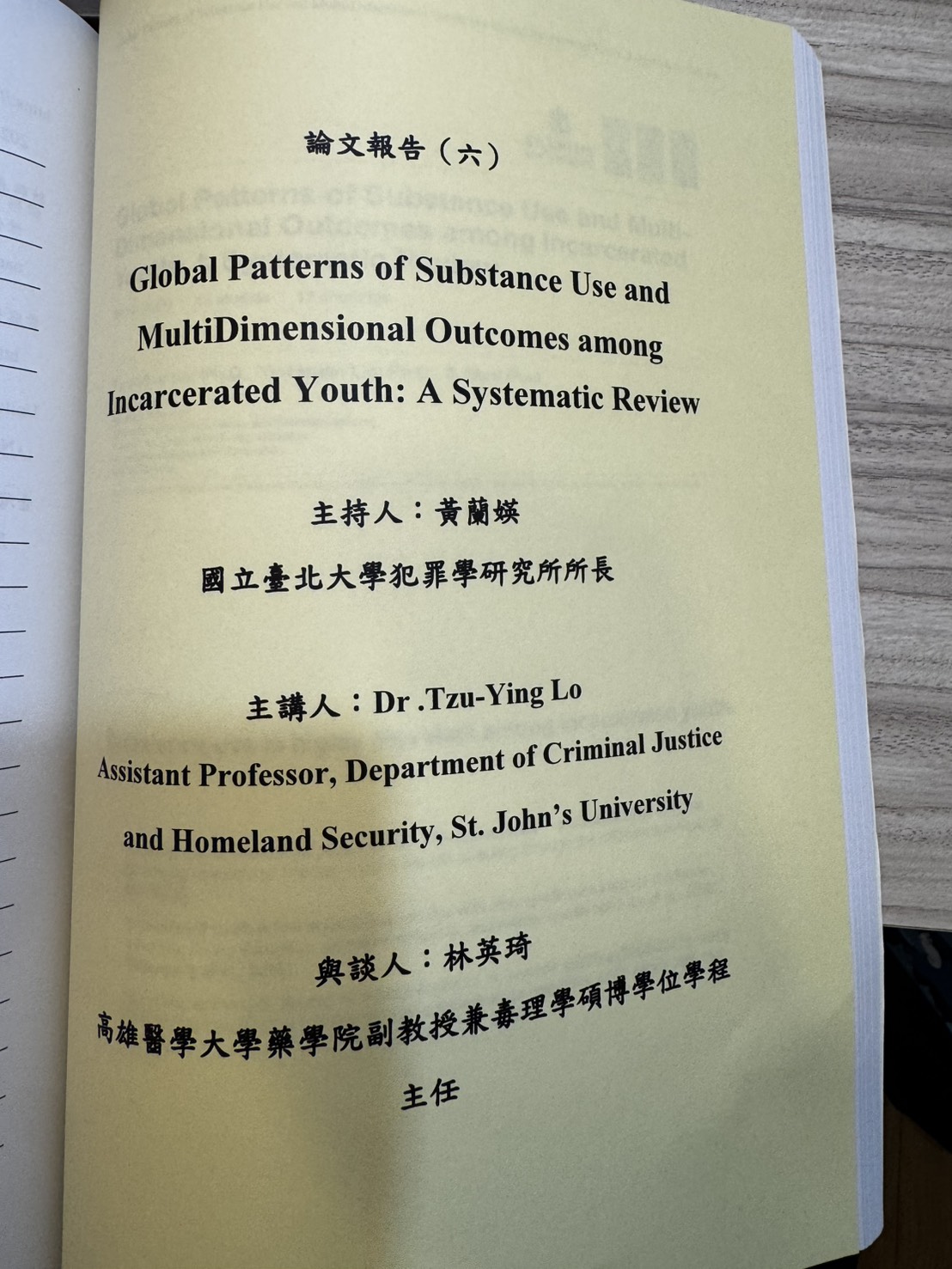
論文報告(六) · Paper VI

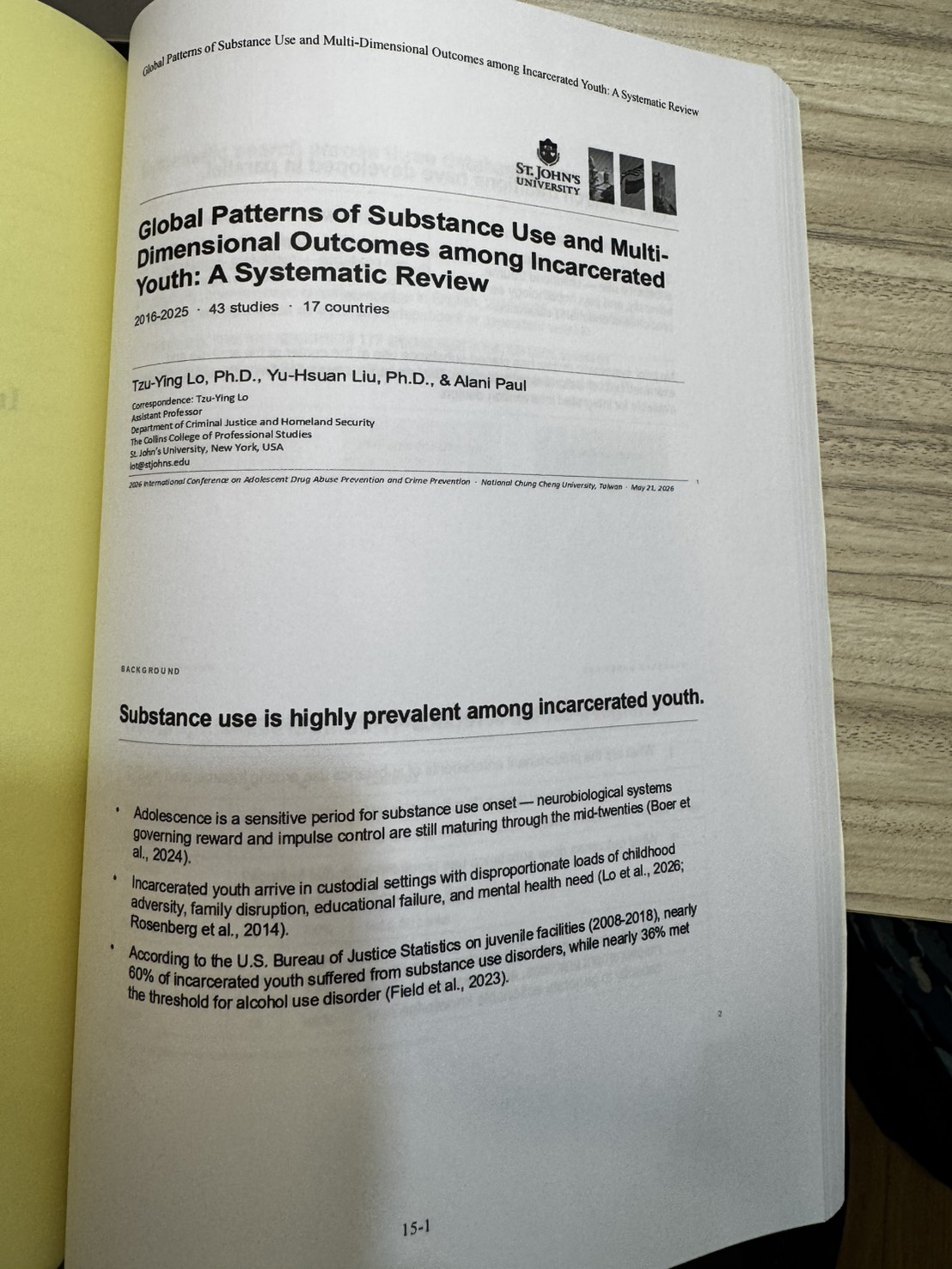
Global Patterns of Substance Use and Multi-Dimensional Outcomes among Incarcerated Youth: A Systematic Review

全球受監禁青少年物質使用與多維度結果:系統性回顧

2016-2025 年 17 個國家、43 篇研究的系統性回顧。童年創傷是物質使用的主要前置因子(66.7%),而物質使用又預測再犯(40%)、精神共病(40%)、攻擊(24%)、自殺自傷(24%)——兩個並行卻互不對話的研究傳統,首次被本文整合於同一分析框架

這場是下午論文場的方法學壓軸——Tzu-Ying Lo 教授(紐約聖約翰大學)以系統性回顧(PRISMA 規範)橫掃 2016-2025 年全球 43 篇受監禁青少年物質使用研究, 指出該領域 60 年來累積的結構性分裂:一支研究問「什麼導致用藥」、另一支研究問「用藥導致什麼」—— 兩股力量「互相不認識卻在回答同一個問題」。本研究是第一篇將兩個分析傳統整合於同一分析框架的回顧。

Core Thesis · 核心論述
  1. 物質使用不是一個離散的行為問題——而是童年逆境 × 精神共病 × 結構劣勢更廣網絡中的一個節點,同時是過去傷害的產物,也是後續傷害的驅動。
  2. 兩個並行研究傳統,互不對話
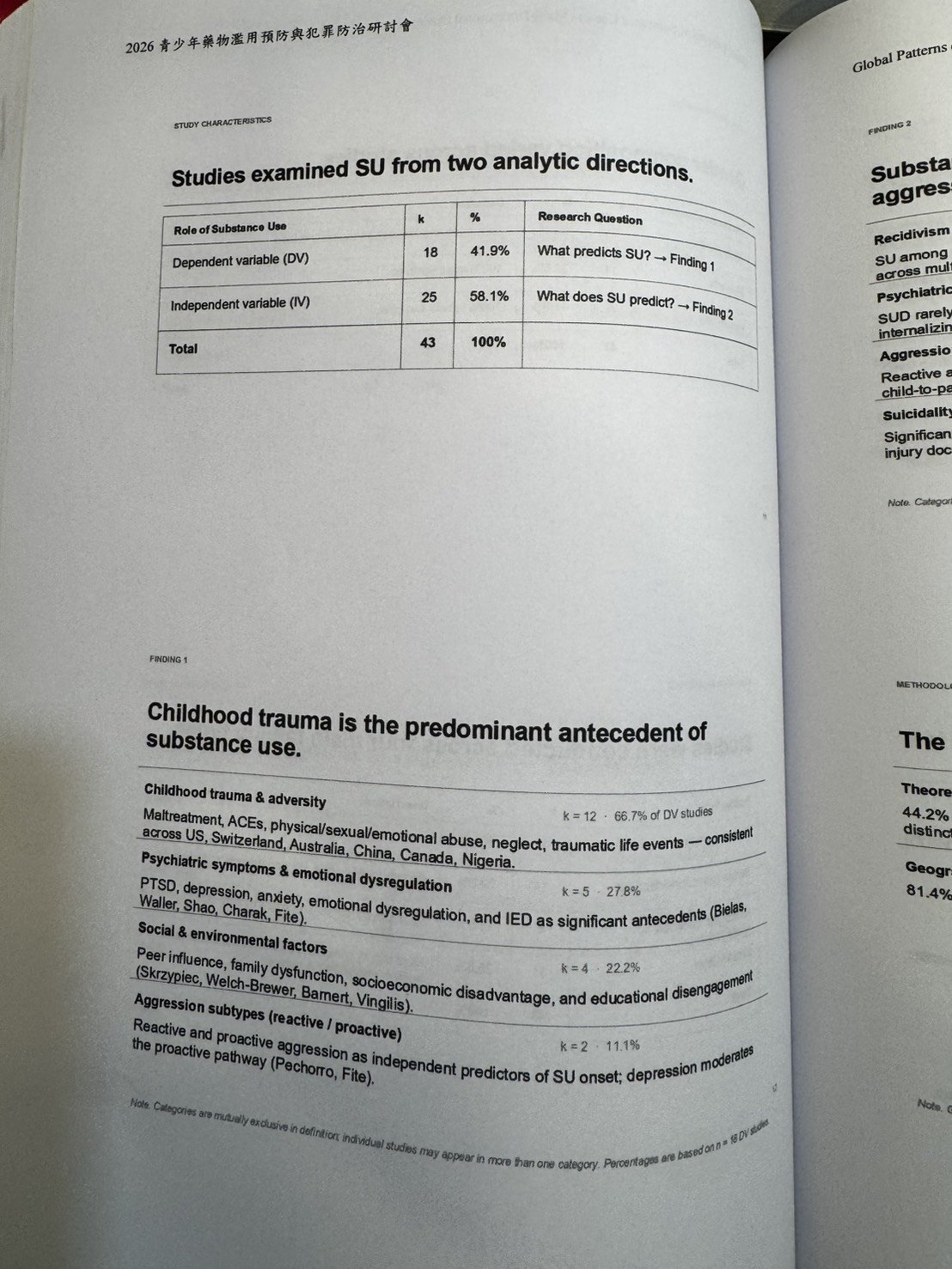
    • ① SU as antecedent(前置):18 篇(41.9%)——童年創傷、逆境、精神病理為主要前置因子。
    • ② SU as consequence(後果):25 篇(58.1%)——預測再犯、攻擊、自殺、機構適應不良。
  3. 童年創傷是預測物質使用的最強單一因子(k=12, 66.7%)——maltreatment、ACEs、性/身/情緒虐待、忽視,跨美、瑞士、澳、中、加、奈及利亞一致。
  4. 「機構成功」應重新定義——不能只看「再犯」,更要看心理健康、自殺自傷、社會功能。
  5. 該領域的結構性限制:44.2% 研究無理論框架、81.4% 來自北美/歐洲/大洋洲——Global South 的聲音嚴重缺席

論文內容重點 · Paper Walkthrough

Opening · 封面

論文報告(六)|Global Patterns of SU Among Incarcerated Youth

主持人:黃蘭瑛 國立臺北大學犯罪學研究所所長。主講人:Dr. Tzu-Ying Lo(紐約聖約翰大學刑事司法與國土安全系助理教授)。與談人:林英琦 高雄醫學大學藥學院副教授兼毒理學碩博學位學程主任。

Background · 背景

Substance use is highly prevalent among incarcerated youth

  • Adolescence is a sensitive period for SU onset——neurobiological systems governing reward and impulse control are still maturing through the mid-twenties(Boer et al., 2024)。
  • Incarcerated youth arrive in custodial settings with disproportionate loads of childhood adversity——family disruption, educational failure, and mental health need(Lo et al., 2026; Rosenberg et al., 2014)。
  • According to U.S. Bureau of Justice Statistics on juvenile facilities(2008-2018):nearly 60% of incarcerated youth suffered from substance use disorders, while nearly 36% met the threshold for alcohol use disorder(Field et al., 2023)。
Problem · 問題意識

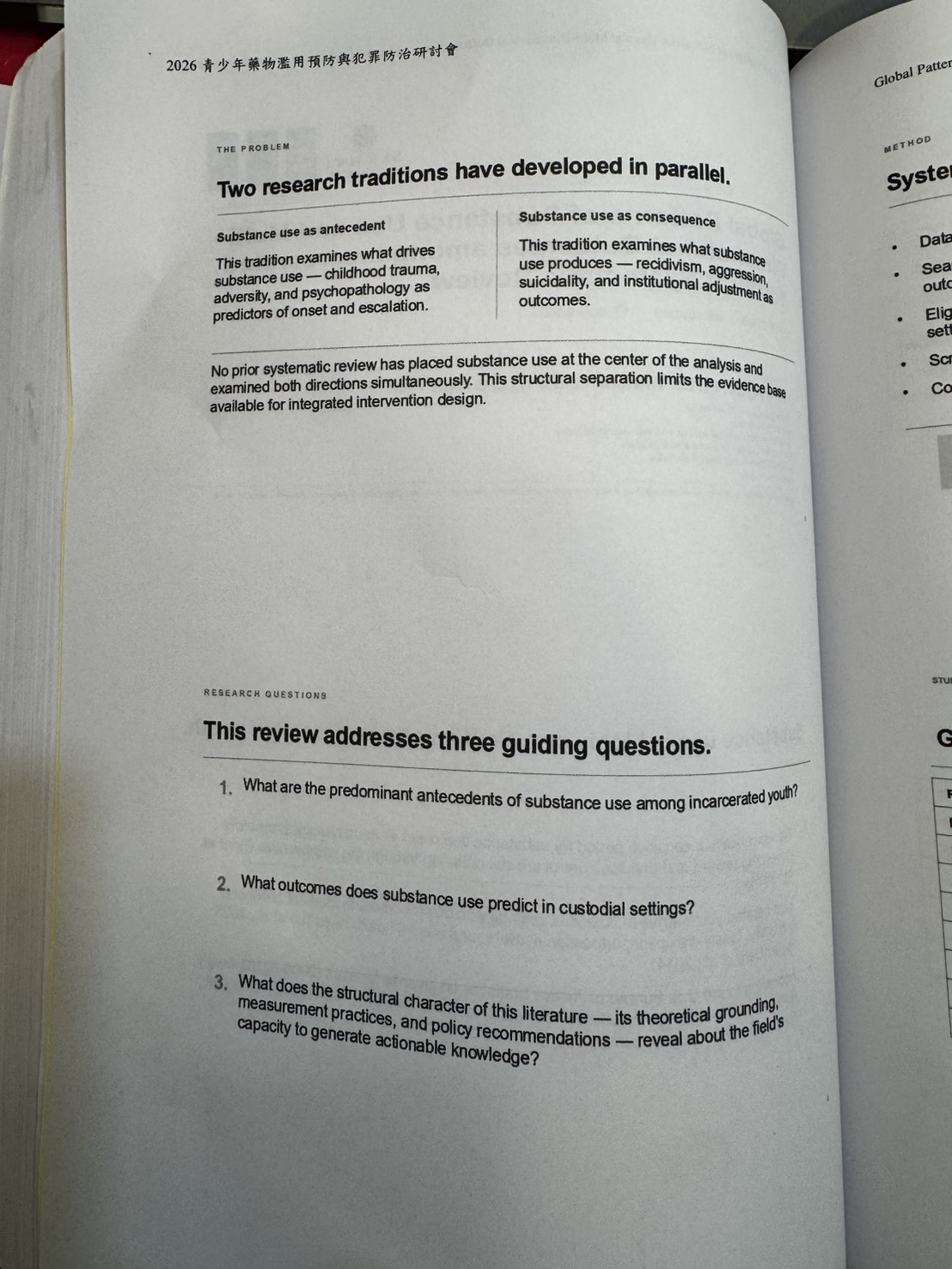
Two research traditions have developed in parallel

SU as antecedentSU as consequence
This tradition examines what drives substance use——childhood trauma, adversity, and psychopathology as predictors of onset and escalation. This tradition examines what substance use produces——recidivism, aggression, suicidality, and institutional adjustment as outcomes.

"No prior systematic review has placed substance use at the center of the analysis and examined both directions simultaneously. This structural separation limits the evidence base available for integrated intervention design."

Three guiding questions

  1. What are the predominant antecedents of substance use among incarcerated youth?
  2. What outcomes does substance use predict in custodial settings?
  3. What does the structural character of this literature——its theoretical grounding, measurement practices, and policy recommendations——reveal about the field's capacity to generate actionable knowledge?
Method · 系統性搜尋

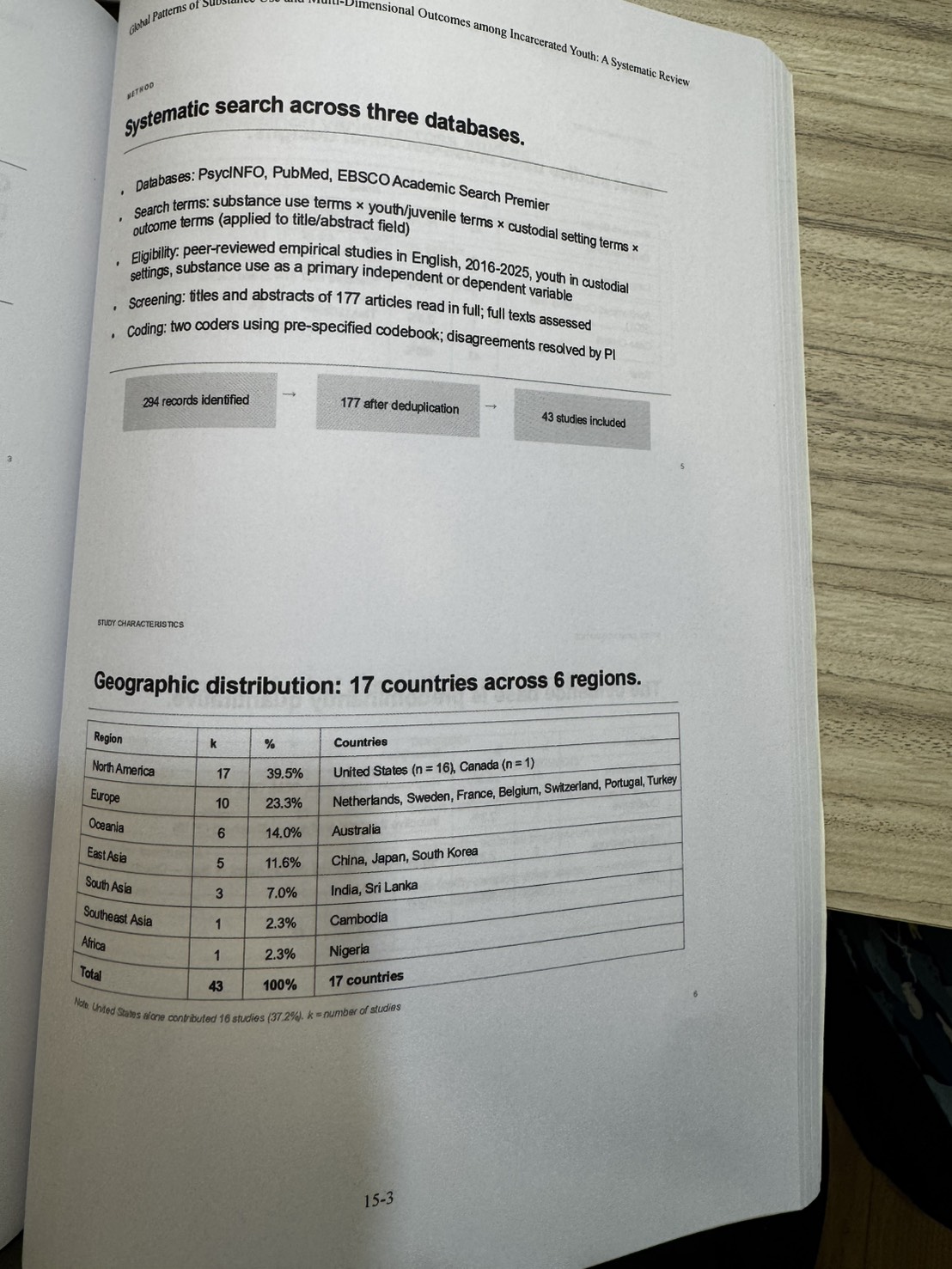
294 → 177 → 43|17 個國家、6 大區域

三大資料庫:PsycINFO, PubMed, EBSCO Academic Search Premier。

檢索詞:substance use × youth/juvenile × custodial setting × outcome(applied to title/abstract)。

納入標準:peer-reviewed empirical studies in English(2016-2025),youth in custodial settings,substance use as primary IV or DV。

篩選:294 records → 177 after deduplication → 43 studies included。雙編碼員(two coders),不一致由 PI 解決。

區域k%國家
North America1739.5%US (n=16), Canada (n=1)
Europe1023.3%Netherlands, Sweden, France, Belgium, Switzerland, Portugal, Turkey
Oceania614.0%Australia
East Asia511.6%China, Japan, South Korea
South Asia37.0%India, Sri Lanka
Southeast Asia12.3%Cambodia
Africa12.3%Nigeria
Total43100%17 countries

單就美國一國貢獻 16 篇研究(37.2%)。

Design · 研究設計

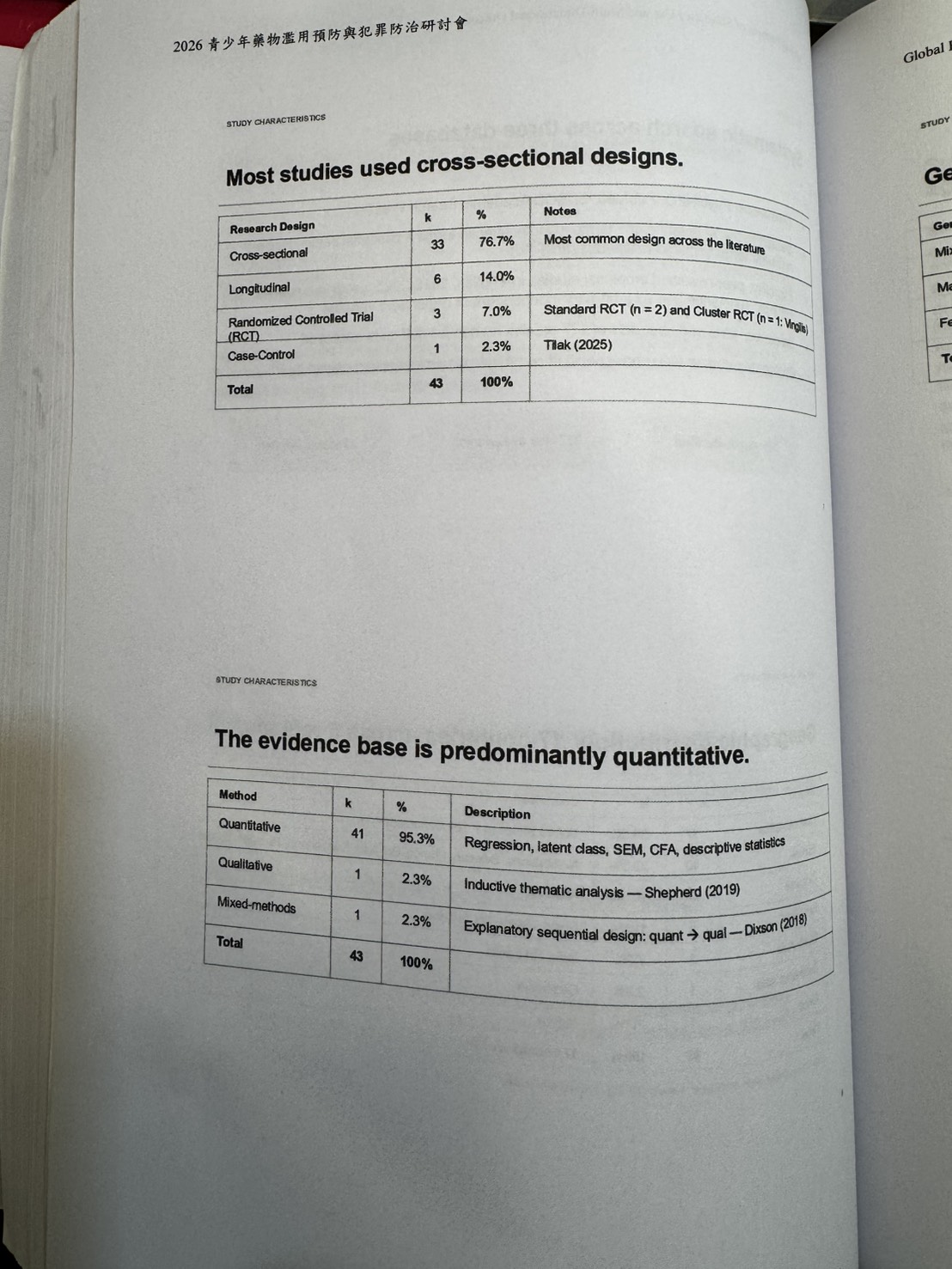
76.7% 橫斷面、95.3% 量化、24 篇混性別

研究設計

Cross-sectional3376.7%Most common
Longitudinal614.0%
Randomized Controlled Trial37.0%Standard RCT n=2, Cluster RCT n=1 (Virgilis)
Case-Control12.3%Tilak (2025)

研究方法

  • Quantitative:41 (95.3%)——regression, latent class, SEM, CFA, descriptive statistics。
  • Qualitative:1 (2.3%)——inductive thematic analysis(Shepherd 2019)。
  • Mixed-methods:1 (2.3%)——explanatory sequential design(Dixson 2018)。
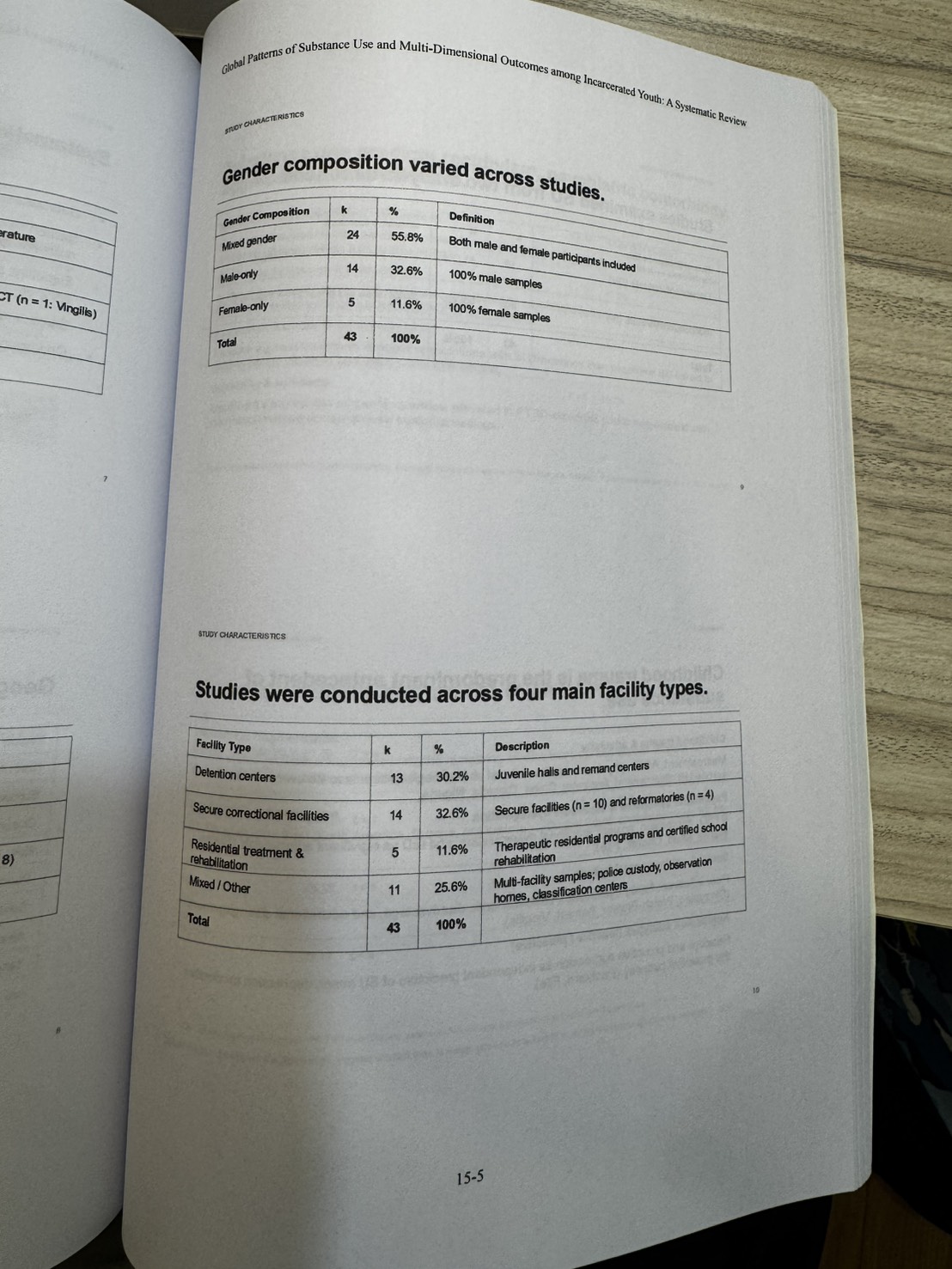
Sample · 性別與機構

性別組成與四大機構類型

性別組成(Gender Composition)

Mixed gender2455.8%男女皆有
Male-only1432.6%100% 男性樣本
Female-only511.6%100% 女性樣本

機構類型(Facility Type)

Detention centers1330.2%Juvenile halls and remand centers
Secure correctional facilities1432.6%Secure facilities n=10, reformatories n=4
Residential treatment & rehabilitation511.6%Therapeutic residential programs and certified school rehabilitation
Mixed / Other1125.6%Multi-facility samples; police custody, observation homes, classification centers
Finding 1 · 童年創傷

Childhood trauma is the predominant antecedent of SU

43 篇研究中,18 篇將 SU 設為依變項(41.9%)探討「什麼導致用藥?」。在這 18 篇中:

前置因子k%內容
Childhood trauma & adversity1266.7%Maltreatment、ACEs、身/性/情緒虐待、忽視、創傷生活事件——跨 US、Switzerland、Australia、China、Canada、Nigeria 一致。
Psychiatric symptoms & emotional dysregulation527.8%PTSD、憂鬱、焦慮、情緒失調、IED 為顯著前置(Bielas, Waller, Shao, Charak, Fite)。
Social & environmental factors422.2%同儕影響、家庭功能失調、社經劣勢、教育斷裂(Skrzypiec, Welch-Brewer, Barnert, Vingilis)。
Aggression subtypes(reactive / proactive)211.1%Reactive 與 proactive aggression 為 SU 起始的獨立預測;憂鬱中介 proactive pathway(Pechorro, Fite)。
Finding 2 · SU 預測什麼

SU predicts recidivism, psychiatric comorbidity, aggression, and self-harm

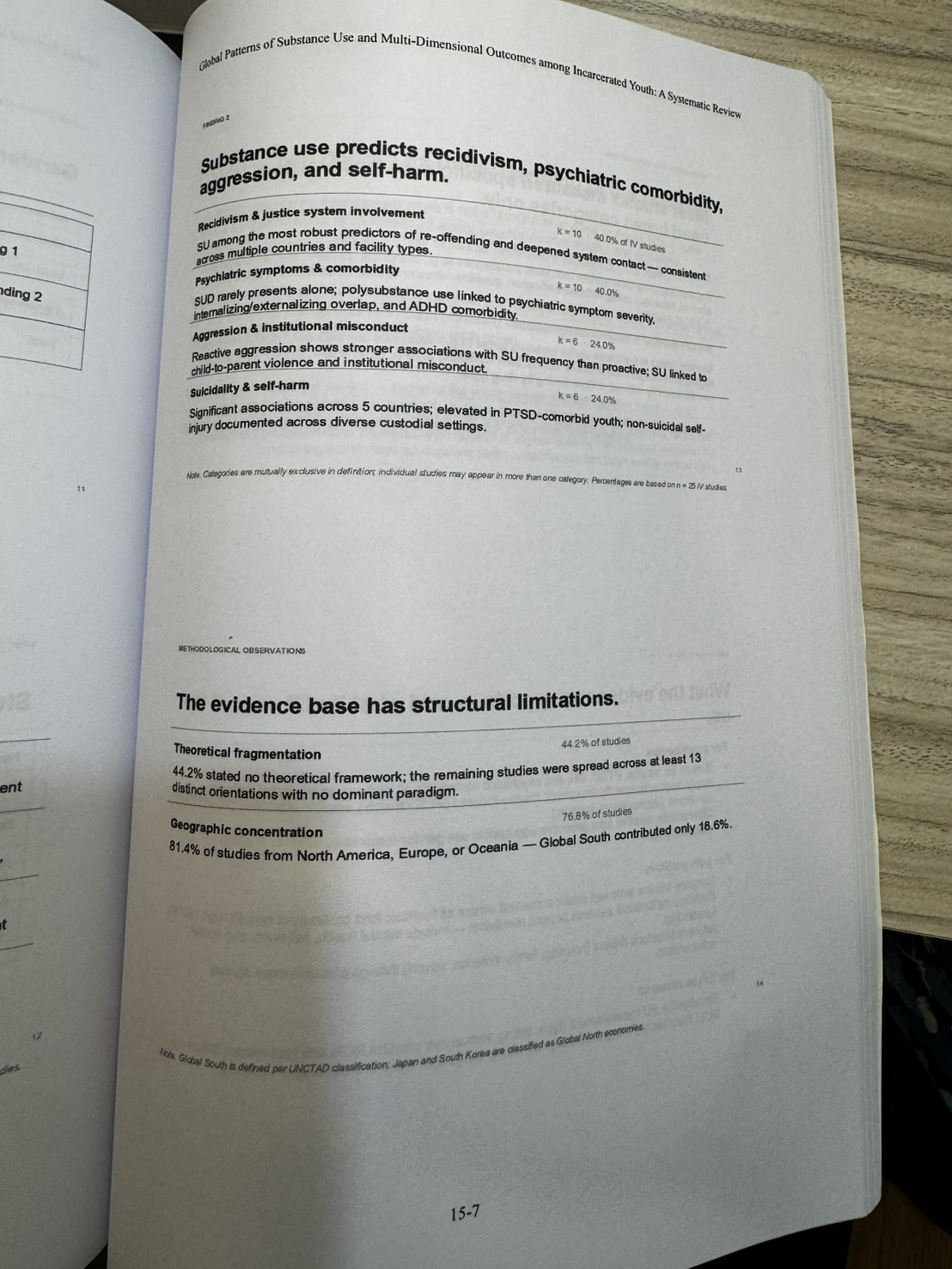
43 篇中 25 篇將 SU 設為自變項(58.1%)探討「用藥導致什麼?」:

結果指標k%說明
Recidivism & justice system involvement1040.0%SU 為再犯與系統深度接觸的最穩健預測因子之一——跨多國、多機構類型一致。
Psychiatric symptoms & comorbidity1040.0%SUD 很少單獨出現;多重物質使用 → 精神症狀嚴重度、internalizing/externalizing 重疊、ADHD 共病。
Aggression & institutional misconduct624.0%Reactive 攻擊與 SU 頻率關聯更強(強於 proactive);SU 連結 child-to-parent violence 與機構違規。
Suicidality & self-harm624.0%跨 5 國的顯著關聯;PTSD 共病青年自殺風險升高;多元監所中皆有非自殺性自傷記錄。

Methodological Observations · 結構性限制

  • Theoretical fragmentation(44.2% of studies):44.2% 明白聲明無理論框架;其餘分散於至少 13 種不同取向,無主流典範
  • Geographic concentration(76.8% of studies):81.4% 來自北美/歐洲/大洋洲;Global South 僅貢獻 18.6%

※ Global South 依 UNCTAD 分類,日本與南韓視為 Global North。

Implications · 政策建議

三大族群的政策建議:實務、政策、未來研究

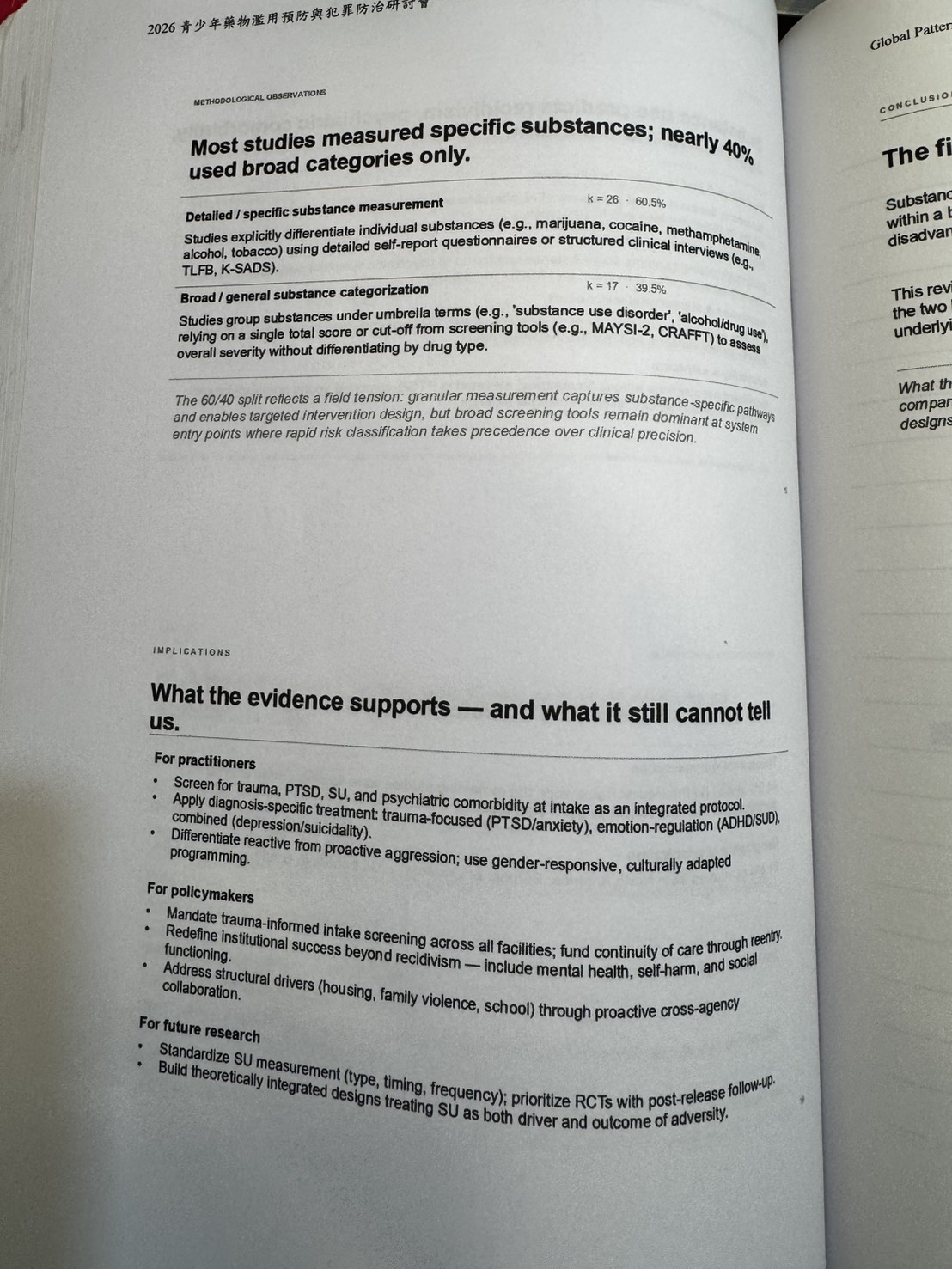
測量學緊張:60.5% 具體物質類別量測(如大麻、古柯鹼、安非他命、酒精、菸——使用 TLFB、K-SADS);39.5% 廣義/概括(如「物質使用障礙」、「飲酒」——依賴 MAYSI-2、CRAFFT 等篩查總分)。granular measurement 利於目標介入設計;broad screening 在系統入口處主導,因快速分類優先於臨床精準

What the evidence supports — and what it still cannot tell us

For practitioners

  • Screen for trauma, PTSD, SU, and psychiatric comorbidity at intake as integrated protocol.
  • Apply diagnosis-specific treatment:trauma-focused(PTSD/anxiety)、emotion-regulation(ADHD/SUD)、combined(depression/suicidality)。
  • Differentiate reactive from proactive aggression; use gender-responsive, culturally adapted programming.

For policymakers

  • Mandate trauma-informed intake screening across all facilities.
  • Redefine institutional success beyond recidivism——fund continuity of care through reentry——include mental health, self-harm, and social functioning.
  • Address structural drivers(housing, family violence, school)through proactive cross-agency collaboration.

For future research

  • Standardize SU measurement(type, timing, frequency);prioritize RCTs with post-release follow-up.
  • Build theoretically integrated designs treating SU as both driver and outcome of adversity.
Conclusion · 結論

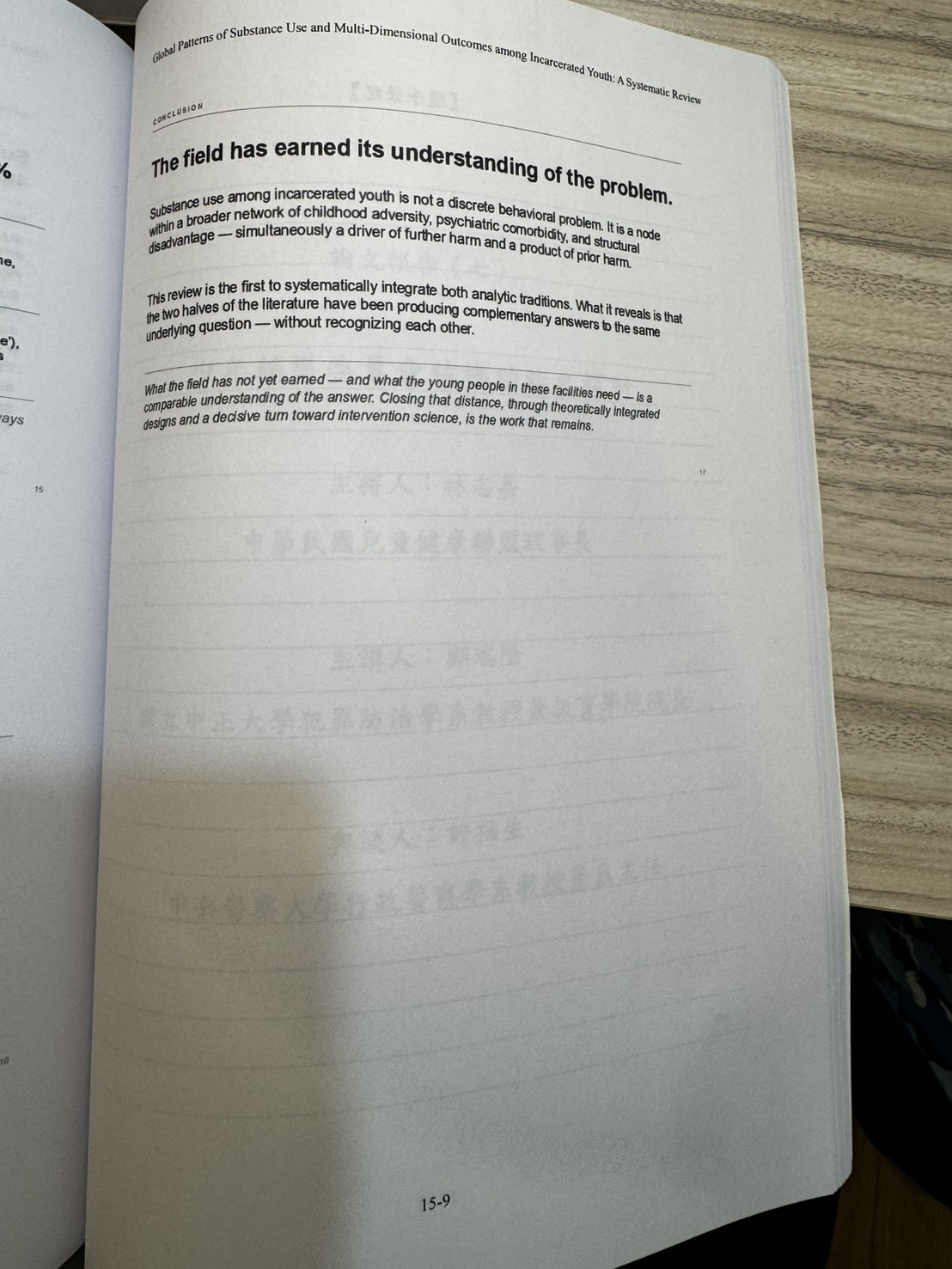
"The field has earned its understanding of the problem."

Substance use among incarcerated youth is not a discrete behavioral problem. It is a node within a broader network of childhood adversity, psychiatric comorbidity, and structural disadvantage——simultaneously a driver of further harm and a product of prior harm.

This review is the first to systematically integrate both analytic traditions. What it reveals is that the two halves of the literature have been producing complementary answers to the same underlying question——without recognizing each other.

What the field has not yet earned——and what the young people in these facilities need——is a comparable understanding of the answer. Closing that distance, through theoretically integrated designs and a decisive turn toward intervention science, is the work that remains.

本場關鍵數字 · Key Numbers

43 / 17 / 60% / 66.7% / 40% / 44.2% / 81.4%

43=納入研究篇數;17=國家數;60%=美國受監禁青少年罹患 SUD 比例; 66.7%=童年創傷在前置因子研究中的佔比(最高);40%=SU 預測再犯/精神共病的研究佔比; 44.2%=無理論框架的研究比例;81.4%=研究來自北美/歐洲/大洋洲的集中度(Global South 嚴重失語)。

對台灣矯正政策的政策意涵

  • 「機構成功」應重新定義——再犯不應是唯一指標,必須納入心理健康、自殺自傷、社會功能;呼應上午第 4 場白鎮福「全人復元」典範。
  • Trauma-informed intake screening 應成為制度標配——所有矯正學校入校時應整合創傷/PTSD/SU/精神共病的篩查;可與第 1 場鄭元皓「再犯風險自動計算介面」整合。
  • Diagnosis-specific treatment 需要本土化——trauma-focused、emotion-regulation、combined 三軌處遇方案,建議由矯正署、衛福部心健司、教育部學特司共同推動。
  • 台灣可填補 Global South 的研究空缺——本研究 17 國中東亞僅佔 11.6%(中、日、韓),台灣的本土實證研究有國際發聲的迫切性。可與下午第 8、9 場(許華孚/葉碧翠)的本土實證資料連結至國際期刊。
  • 對國教盟與兒少倡議聯盟的意涵:與本日上午第 4 場(國教盟主場「全人復元」)、下午第 7 場(兒少健盟主場「少輔會結構」)形成三重證據鏈——個案、結構、國際——支持兒少倡議聯盟推動跨部會「創傷知情司法(trauma-informed justice)」立法。